-
No Wait States After First Data Phase
- In PCI, a target could insert wait states during any data phase if it wasn’t ready.
- In PCI-X, wait states are only possible before the first data phase.
- After the first data is transferred, the rest must flow continuously (no more stalls).
✅ Why? Because PCI-X gives the target device all the info up front (see next point).
- Attribute Phase = Transfer Size Known in Advance
- PCI-X adds an Attribute phase to the transaction.
- This phase tells the target device how much data will be transferred.
- The target can pre-allocate buffer space and prepare, avoiding mid-transaction delays.
- Burst-Oriented Transfers
- Most PCI-X cycles are burst transactions (not single data beats).
- Transfers are typically done in 128-byte blocks (32 dwords if bus is 32-bit wide, or 16 dwords if 64-bit wide).
- Bursts reduce bus overhead and maximize throughput.
- Efficiency Gains
- Since wait states are minimized and data is moved in large, predictable bursts,
→ The bus has higher utilization.
→ Devices can manage buffers more efficiently. - This is one of the main reasons PCI-X outperforms legacy PCI despite similar signaling.
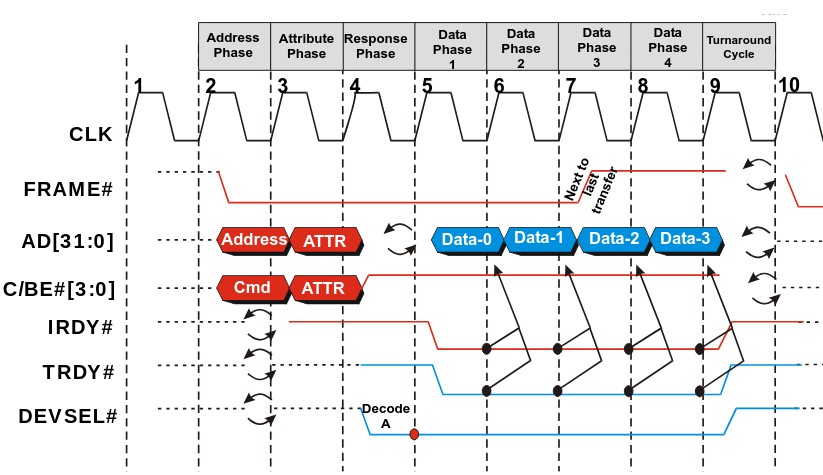
- Since wait states are minimized and data is moved in large, predictable bursts,